In the 2023 launch class, half the new drugs missed their pre-launch first-year forecast. The ones that beat it had launched before.
That comes from Trinity Life Sciences, which studied the 2023 US launch class in a report published in November 2024. Half the class came in under its pre-launch first-year forecast. Thirty-nine percent beat it. The rest came in on it.
Trinity names two things that separated the ones that beat it. Real demand in a space with high unmet need, and launch experience with a track record in that market. You cannot buy the second one. A first launch has no track record, by definition.
Then look at what Trinity found when it broke out first-launch companies on their own. Thirty-three percent of them beat forecast, against twenty percent in the years before. Fewer than the class overall, and climbing fast. The experience gap is real. It is not decisive.
Missing the forecast is not new. McKinsey found back in 2014 that roughly two thirds of new drugs miss the pre-launch consensus forecast in year one, and that the ones that fall short usually keep falling short for two more years.
Which means the outcome is mostly set before anyone sees a campaign. It gets set closer to two years earlier, in a sequence of commercial decisions a science-led team has never had to make and does not know the order of. At the time, none of them look like commercial decisions. They look like ordinary calls about a trial, a label, an indication, a first hire.
It is also getting harder to win big. IQVIA, writing in October 2025, cites a study of 559 launches in which only 1 in 10 products launched between 2020 and 2024 crossed $100 million in first-year sales, down from 1 in 5 just five years earlier. And the window for judging whether a launch worked has stretched from the traditional six to twelve months to roughly three years, as payer dynamics, provider behavior, and more complex patient engagement push the real verdict further out.
The science is not what decides this. The sequence does. And for a company whose leadership team is entirely scientific, that sequence stays invisible until the runway to fix it is mostly gone.
What launch experience actually buys you is knowing the order. And unlike the experience, the order can be written down.
So here it is, from roughly two years out to launch day. One decision that has to come before the others, then six more in the order you actually face them. Each one shapes the next, which is why taking them out of order means rebuilding work you already paid for.
Before anything else, somebody has to own this
The most natural move for a science-led team is to wait. Wait until the data reads out, wait until the raise closes, wait until there's a real budget for a real commercial hire, then bring in the person who owns this. That instinct is completely reasonable, and it's the first decision in this sequence that goes wrong.
FTI Consulting wrote about this exact handoff in a piece published January 30, 2026, and put it plainly, commercialization success is determined long before regulatory approval. Strategy, operations, and capital have to move in lockstep as a company approaches its pivotal trial. Wait for the hire, and two years of decisions below start piling up unowned. By the time the seat is filled, most of them have already been made by default, usually by whichever function had the loudest voice in the room that quarter.
The only detailed public timelines for this come from two firms that sell hiring, a 2018 account by an executive search firm founder and an undated page from a staffing agency. Both describe nearly the same ramp. Digital groundwork roughly two years before the regulatory decision date, the core commercial team including a chief commercial officer around eighteen months out, medical science liaisons around twelve, field managers four to six months out, reps last. That is not a standard. It is two vendors agreeing with each other.
I took every company I could find that got its first ever FDA approval between 2023 and 2026, then went back through their own press releases and filings for the earliest point each one named a senior commercial owner in public. Nineteen had both dates on the record.
The median was 32 months. Thirteen of the nineteen named someone more than two years out.
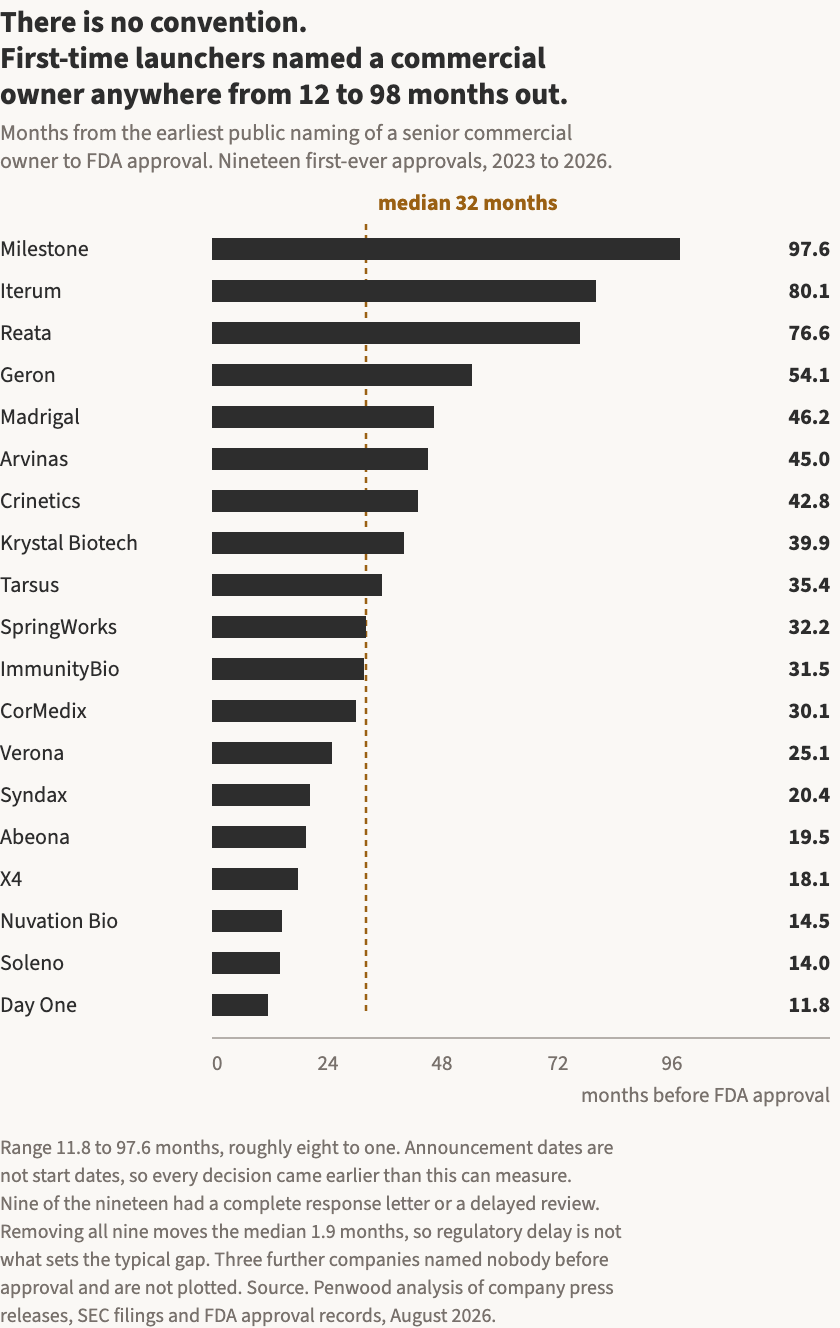
The spread is the finding, not the median. Twelve months at one end, ninety-eight at the other, a ratio of roughly eight to one. Even the fastest company in the set named a commercial owner nearly a year before it had anything to sell.
I expected the long tail to be regulatory delay, companies that staffed against a PDUFA date and then got pushed. Nine of the nineteen did take a complete response letter or an extended review. But strip all nine out and the median moves by 1.9 months. Delay stretches the extremes. It does not explain where the typical company sits.
What sits at the top of that chart is a bet. Reata named a chief commercial officer in 2016, 76 months before the approval it eventually got, for a drug that never arrived. That is a real cost. But look at what Reata actually bought too early. A person, on payroll, for years. Naming an owner is not that. It costs nothing.
The other end is worth just as much attention. Three companies in my search never named a commercial owner before approval at all. Verrica got a drug approved in July 2023 and did not name a chief commercial officer until February 2026, thirty-one months after it had something to sell.
Two caveats, both real. An announcement is not a start date, so every decision in there was made earlier than I could measure. And the method can only see companies that announce, which skews toward the ones running active investor relations, and those are plausibly the same companies that start early anyway.
So there is no standard to comply with here. There is only how early you decide to start.
None of that requires the permanent hire to already exist. It requires someone, right now, whoever is closest to the commercial question inside your company, to own it as their explicit job. That's usually the CEO at this stage, and that's fine. The point isn't who. The point is that the sequence has an owner starting today.
1. Define the customer, honestly, before the plan assumes one
A scientific team's instinct, understandably, is that the customer is the physician who understood the trial data. That's the person in the room during every advisory board, every KOL call, every abstract presentation. It feels like the customer.
It's a third of the customer, at most. IQVIA's recent launch research describes the real model this way, companies now have to activate patients, persuade payers, and educate providers in parallel, not in sequence. The provider who understood your trial still has to change a habit, and in oncology, where IQVIA tracked more than 26,000 providers across launches from 2012 to 2025, only about 1 in 5 consistently adopted a new product within its first two years. Adoption speed varies enormously by specialty, so that is an oncology number and not a universal one. The patient has to build a new routine around something that didn't exist in their life yesterday. And the payer, who decides what actually gets covered, has become dramatically harder to satisfy. First-year rejection rates for patients climbed from 40 percent to 64 percent over six years, IQVIA reports, and it puts durable rejection at more than 60 percent of new patients for many brands. Those are patients blocked at the counter, not products refused coverage outright.
I'm not talking about access strategy here, that's a different conversation with a different set of specialists. I'm talking about something earlier and more basic, whether your plan gets built around the actual, plural, simultaneous set of people who have to say yes, or around the one person your scientific team already knows how to talk to. Get this wrong two years out, and every plan built downstream, the positioning, the channel choices, the field model, gets built for the wrong buyer. Nobody notices until adoption comes in soft in year one.
2. Test market reality before the strategy locks
Everything above is a hypothesis until someone tests it against people who are not your own team. Most science-led companies skip this one entirely, not because they don't value it, but because it looks like a budget line they don't have yet, run by a team they haven't hired.
IQVIA's Ready, Set, Launch post, published October 31, 2025 and reporting its own launch analysis, is specific about what separates the winners here. The launch cohorts that outperform spend nearly twice as much on pre-launch research and talk to roughly twice as many providers doing it. IQVIA's read is that gradual, consistent investment across the six months before approval outperforms a last-minute surge. And it found that roughly 65 percent of pre-launch consumer ad spend still lands in the final quarter before launch, after most of the strategic decisions it should have informed are already locked.
You don't need a standing market research department to run a version of this. IQVIA notes there are no industry-wide benchmarks to compare against when you try to measure pre-launch success, so nobody can hand you a template anyway. You have to build the read yourself, and the point of building it is not volume. It is knowing which conversations to prioritize with the limited time you have before the strategy locks.
There's also a formal, legal channel worth knowing about here, specifically with payers. The Pre-Approval Information Exchange lets a company send product information to payers before approval, under a misbranding safe harbor Congress wrote into the Food, Drug and Cosmetic Act in 2022. There is no clock on it. The window opens as soon as there is an unapproved product or use and something truthful and not misleading worth sending. What the law constrains is what you send and what disclosures ride along with it, not when you start. And the permitted set is wider than most teams assume, covering the indication under investigation, the anticipated approval timeline, pricing information, patient utilization projections, and factual presentations of study results. This is a channel your access people run, not a marketing one, but the decision about when to open it is a commercial decision and it usually falls to nobody. If no one on your team has worked it deliberately, that is a window sitting unused.
3. Choose the brand's lead story and lock it deliberately
By the time Phase 3 data is reading out and the label is starting to take shape, one more decision can't wait any longer, what story does this brand actually tell first.
Simon-Kucher, writing on February 9, 2026, is direct about the pricing half of this. The first approved indication functions as a price anchor. Its read of oncology and rare disease is that early launches often lead with indications carrying high unmet need, strong differentiation and attractive price potential, with lower-priced indications following afterward to protect list price. Chronic-disease portfolios follow different patterns, so that is not a universal rule.
That is the pricing case. The identity case is mine. The first indication also decides what prescribers think this drug is for, and an identity is harder to reprice later than a number is. Get the order backward and you spend years trying to reposition a brand that already has an identity, just not the one you wanted it to have.
This is a decision, not an accident, and too many science-led companies let regulatory timing make it for them by default. Whichever indication clears review first becomes the story, whether or not it's the strongest one. That's backward. The lead story gets chosen on purpose, before the label locks it in for you.
4. Sequence the indications and markets by where you can win first
This one gets confused with the last constantly. The one before is which story you tell. This one is which population you go after first, and in what order after that.
The instinct is to sequence by size, chase the biggest population first, or by speed, take whichever regulatory pathway clears fastest. Neither is the right filter. The right filter is where you can actually win, where your differentiation is sharpest and you can own a population outright before a competitor moves in. A peer-reviewed study published February 13, 2023, tracking 118 indications across 31 multi-indication medicines, found the mechanism in the data. First indications were roughly twice as likely to win conditional marketing authorization and orphan designation as later indications for the same drug. And even with that advantage, only 71 percent of those indications cleared all four of the FDA, the EMA, Health Canada and Australia's TGA. Indications get stranded in some markets while the same drug already sells in others.
Get the order right and the first indication builds the authority the second one can borrow. Get it wrong, chase the biggest market first because it looks like the better bet on paper, and the second indication inherits nothing. It has to build its own credibility from zero, on a fraction of the investment the first one got. I have written about this trade-off at more length, two companies launching the same class of drug, one leading with the sharpest indication and one with the biggest, and the ceiling that follows from that one choice.
5. Design field readiness as a kickoff decision
By the time you're deciding how the field organization gets built, three of the decisions above should already be behind you, who the customer is, what story you're telling, which population comes first. Field readiness gets sequenced off the back of those, and it has to get decided the same day the brand plan and the launch date lock, not queued up afterward as an execution detail.
In my time at Novartis leading international marketing operations, I worked through seven brand and indication launches in under two years. We hit our milestones, largely because field readiness was never treated as something that happens after the strategy is finished. It got built alongside the campaign, the content, and the channel plan, from the day of kickoff, because it has to be built for behavior change, not product knowledge, and behavior change takes real time to prepare for.
The cost of getting this timing wrong is concrete. ZS models a hypothetical 300-person US sales force at roughly $100 million a year, and hiring six to nine months before launch puts about $75 million of that at risk before a single approved sale. Compress the prep window to three or four months and you roughly halve it. The line from ZS that sticks with me is simple. Launches fail not because assets lack promise, but because companies invest too little, too late. Field readiness is where that shows up most literally, as money spent before there is anything approved to sell.
6. Name who owns the number
Every launch runs a tracker full of green checkmarks. The regulatory milestone hit on time. The kickoff happened on schedule. The materials cleared review before the deadline. None of that tells you whether the actual number, the one investors and the board are watching, is going to land where the forecast said it would.
L.E.K. Consulting, writing on October 3, 2025 from its work with global biopharma launch teams, names the real gap directly. Ambiguity about who decides, when, and with what authority remains one of the most common barriers to launch execution. The decisions that actually move the year-one number, which story leads, whether the sequencing held, whether the field got the runway it needed, don't have a line item on a gate chart. Nobody signs off on them because nobody was assigned to own them in the first place.
Consulting firms have built a long list of frameworks trying to formalize this, scorecards, tiered maturity models, launch dashboards. None of them is a neutral, independently validated standard. Every one is a private construct built by whoever's selling it, which is worth knowing before you adopt someone else's proprietary system as though it were an industry rulebook. That includes the sequence in this article. I built it from what I have seen work, not from a validated standard, and you should hold it to the same test. What actually closes the gap is simpler than any of that. Name a person, not a committee, who owns the commercial number itself, starting now, not at launch. The owner named early is the owner who is accountable for the number later.
Make it one connected, visible process
Read the six decisions above back to back and it's tempting to treat them as six separate projects, run by whichever function happens to own that piece of work, checked off a list in whatever order they come up. That's the mistake. They're not six projects. They're one process, and the moment they get split across four teams that can't see each other's work, the sequence stops being a sequence and turns into four task lists nobody is actually coordinating.
Split them up and every function ends up working off different numbers, which is the same problem wearing a different face. Clinical is watching the data. Commercial is watching the market. The executive team is watching the runway. Left alone, each optimizes for its own read of what matters, and the first time that shows up as a real problem is usually launch week, when it's too late to fix quietly. The fix isn't a kickoff meeting or a shared slide. It's shared readiness milestones all three functions actually report against, starting well before launch, so disagreements surface as a data conversation months in advance instead of a surprise in year one. For a science-led company that is the moment the scientific team stops treating trial endpoints as the only real numbers and starts treating the commercial numbers as equally real.
I wrote about this exact failure mode recently. A Series B launch usually isn't short on staff. It's short on visibility. Nobody fixes a fragmented process by hiring one more person into it, that just adds another task list to the pile nobody can see across. What actually fixes it is deciding the whole connected sequence before the first asset gets built, and making every decision in it visible to everyone who touches the launch, instead of living in four separate inboxes that never talk to each other.
That is the decision underneath all six. Not one more decision to add to the list. The decision to treat all six as one thing, decided in order, visible to the whole team, before launch day arrives instead of during it.
Start with the one nobody owns
The science is the hard part, and your team already did that. Years of it, at real personal cost, on the bet that it would reach somebody. Whether it actually does comes down to a sequence of commercial decisions that starts long before launch day, and almost every one of them is already yours to make.
So make that move this week, well before the permanent commercial hire arrives. Go through the six decisions above, and the ownership question sitting in front of them, and find the one nobody in your company owns. In most companies I talk to it is that ownership question, which is why it comes before the six rather than inside them. Not the decision that feels most urgent this month. The one that is genuinely unowned, today, while everyone stays heads down on the data.
Then put a name and a date on it. Not a plan to revisit after the readout. An actual name, an actual date, by Monday. That is the one place in this whole sequence where waiting is itself the decision, and every other decision waits behind it.
When the number lands, the board will read it as a verdict on the science. It will not be. It will be a verdict on decisions made quietly, two years earlier, by whoever was paying attention. Be the company where somebody was.